
Before a contractor calls any rep, the practical question is usually the same: what does this system take to run on my roof, with my crew, and what does the bond do once it is down? This guide sets out how single-canister and two-part cart systems differ on each of those points, what QDEK publishes for its own products, and where you should insist on seeing it yourself.
What actually differs between the two approaches
A two-part system meters two chemical components together at the point of application. That proportioning has to happen somewhere, which is why these systems are normally supplied as paired tanks or a wheeled cart with hoses running out to the applicator.
A single-canister system carries the adhesive pre-formulated in one pressurized canister. UNO‑FOAM® | QD3000 is the 48 square insulation adhesive for insulation and cover boards. UNO‑GRIP™ | QD2040 is the TPO/EPDM adhesive for TPO and EPDM membranes, including fleece-backed systems.
Neither approach is universally correct. The question is which one suits the roof, the crew and the access you actually have.
Setup and what has to reach the roof
With a two-part cart system, the proportioning equipment itself has to get to the deck and be positioned, connected and checked before any adhesive is applied. On a roof reached by hoist or ladder, or one broken up by equipment and penetrations, that is a real constraint worth planning around.
A QDEK canister goes up as a canister. The specified equipment is a spray gun, a hose and a wrench — the UNO‑FOAM® toolkit pairs the M160-18 wand gun with an M180-12 hose; the UNO‑GRIP™ toolkit pairs the M125 gun with the same hose. There is no cart to lift, site, or level.
- Two-part: proportioning equipment on the deck, hose runs from the cart, pre-start checks
- Single canister: canister, gun, hose — carried by hand
Crew size and how the work is divided
Setup effort drives crew allocation. Equipment that must be tended, repositioned and monitored generally occupies someone; a canister carried to the work does not.
This is the point contractors should test on their own roof rather than take from any manufacturer's page, including ours. Ask a rep to run the product on a real section and count the people it takes.
What we measured in our own 63 ft application exercise
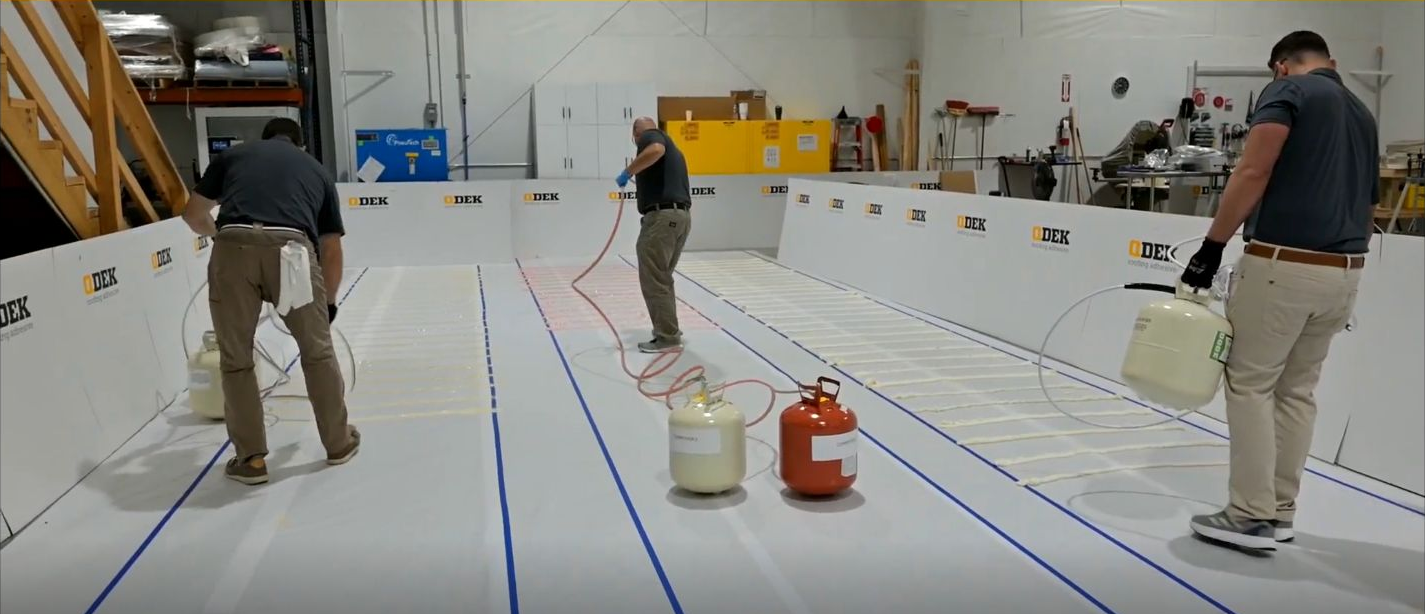
QDEK ran a timed application exercise in house, as a training and sales-meeting demonstration: three lanes, 63 ft each, three applicators working side by side at normal speed, all timed from the same start. Two lanes used two-part systems; the third used UNO‑FOAM® | QD3000.
UNO‑FOAM® finished in 1:58.7. The two-part lanes finished in 3:48.6 and 5:53.8. Those are the times observed in this one exercise, against these two lanes, on this floor.
The exercise was set up to be controlled: identical measured lanes, the same bead pattern and spacing, all three timers started together, indoors on a level floor. Each timer covers application only — it starts at first application in that lane and stops when the lane is complete, so it does not measure equipment setup, mixing or cleanup.
This is QDEK's own exercise, not an independent study, and it is not a guarantee about two-part systems generally. Each lane was run by a different applicator, and real roofs add variables a controlled floor run cannot — temperature, wind, deck condition and crew experience among them. Treat it as one observed example, and ask a rep to run the same comparison on your roof.
- Lane 1, two-part: 5:53.8 — 10.7 linear ft/min
- Lane 2, two-part: 3:48.6 — 16.5 linear ft/min
- Lane 3, UNO‑FOAM®: 1:58.7 — 31.8 linear ft/min
- Timers started together at first application and stopped at lane completion — application time only
Working time and cleanup
UNO‑GRIP™ | QD2040 has a 2–4 minute dry time and an open time of over an hour, with an adjustable 7–17 inch spray pattern from the UniJet 11002B tip. Confirm the current TDS before spraying, because conditions on the roof affect timing.
Cleanup scales with the equipment in play. A gun and hose are cleaned out with an approved adhesive remover; proportioning equipment and its lines add to that work at the end of the day and at every stop and restart.
Coverage, so the comparison is on the same basis
Compare adhesive systems on published coverage per unit, not on canister count. One roofing square equals 100 sq ft.
A 22 L UNO‑FOAM® canister covers up to 48 squares, depending on application. For membrane bonding, a 22 L UNO‑GRIP™ canister covers up to 10 squares / 1,000 sq ft of bonded area. The coverage calculator works these out for a given roof area and number of bonded layers.
The performance question underneath all of it
Convenience is only worth discussing if the bond performs. A QDEK-bonded assembly met the 90 psf passing grade in independent ANSI/FM 4474 simulated wind-uplift testing, and the observed failure above that point was at the cover-board facer, not at the QDEK adhesive bond.
That result applies only to the assembly that was tested and is not an FM Approval or listing. The full test summary sets out the chamber, the pressure steps and what the result does not cover.
How to decide for a specific project
Start with the bond line: insulation and cover boards are attached with UNO‑FOAM®; the membrane above is bonded with UNO‑GRIP™. Then weigh access, crew availability and cleanup against the coverage you need.
Where wind-uplift performance governs the assembly, work from the roof-system manufacturer's requirements and the project documents, and ask a rep to review the specific build-up with you.
Coverage varies by substrate and application. Confirm the current TDS/SDS, roof-system requirements, and project documents before use.